

Finding accommodation can be one of the scariest parts of moving to another country. You are flying to a new place without a permanent living situation, and when you arrive, you will need to very quickly find a place and sign a lease in a foreign language.
In many ways apartment hunting in Spain will be very similar to apartment hunting in the U.S, but there are some key differences as well. I will walk you through the process of finding your own place in Spain.
Before Your Flight
After Arriving
Browse/Don’t Buy Apartment Listings
Do not buy/sign/reserve any type of apartment from a stranger before seeing it first in person. Housing scams exist. Do not make yourself an easy target.

Instead, before you leave for Spain, it’s a good idea to browse some key websites and familiarize yourself with the market in your area. It can give you an idea of the average rates in your region. It’s also good to see what type of apartments you can expect. Make sure to plan your apartment around your commute. Check public transit options that get you to and from your assigned school. It’s also encouraged to shorten your commute if you can by living closer to your school.
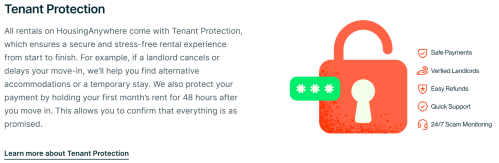
https://housinganywhere.com/ – A great option if you want to arrange accommodation before (or after) arriving in Spain. Browse furnished rooms and apartments and book your place online before you arrive. Especially in big cities like Madrid, this option can take away a lot of stress of apartment hunting.
It’s also a great convenience for those who don’t feel confident apartment hunting in a foreign language in a foreign country.
https://www.idealista.com/en/ – It is the most common method of finding a place in Spain for locals. Browse apartments and check out the posted pictures and conditions. Contact the landlord directly and book an appointment to visit before signing.
https://www.fotocasa.es/en/ – This is another commonly used website for renting apartments in Spain. Just like Idealista, you can browse apartments and check out the posted pictures and conditions before contacting the landlord.
Join specific Facebook groups for housing in your region. You will find many different posts advertising available rooms and apartments. Remember, do not sign or buy anything from a stranger before seeing it in person!

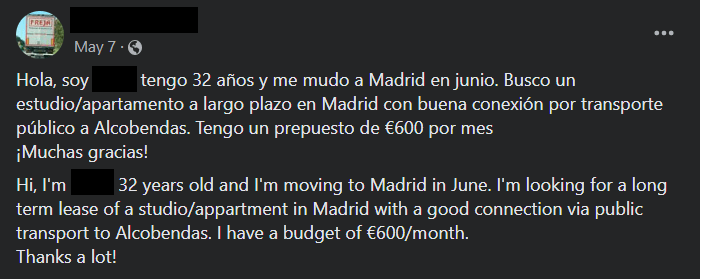
IMPORTANT ADVICE: DO NOT make posts online giving your budget for an apartment. Many auxiliaries are widely unaware of the market rates for renting apartments in Spain. They grossly overbid on apartments by posting high budgets online. This not only makes it difficult for natives to find apartments, it also raises the cost of renting overall for everyone!
Do not make a post like this:
Later on when you are searching for apartments while in Spain, you can just respond and apply to advertised openings on Facebook, Idealista, or Fotocasa.
Join specific Facebook groups for auxiliaries in your region. Auxiliar de Conversación groups will have posts looking for roommates around the time of entry.
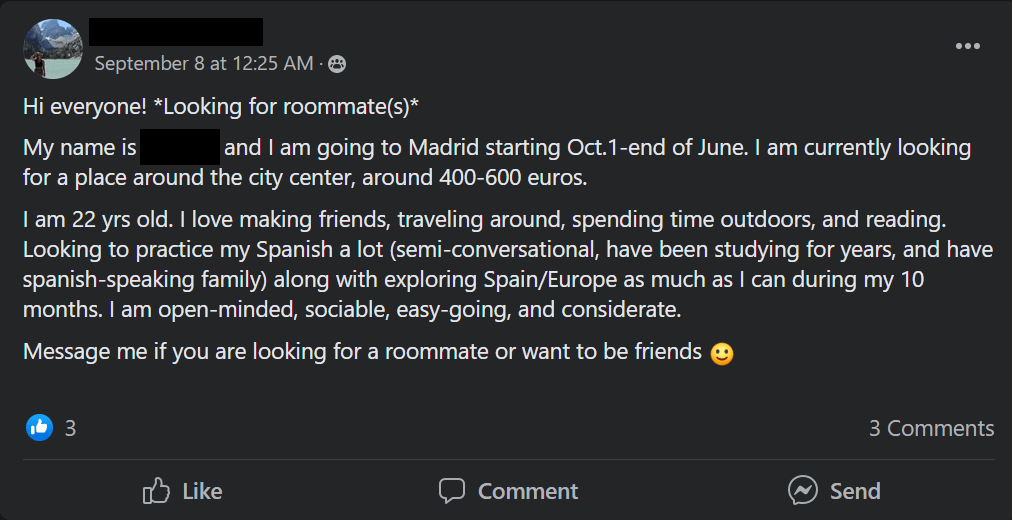
You should also prepare a short, 50 word introduction (in Spanish) for when you apply for an open listing. Mention who you are, the program you are in, and how long you will need the lease. You can give some information about your interests and background. Talk yourself up. In my experience, landlords are more eager to rent to people they like. You can copy and paste this message to emails, WhatsApp numbers, and open postings.
If you are placed in a small town without these resources, you can ask for help through your school. More than likely a teacher or family member of a teacher or student will have a room available.
Set Up Temporary Accommodation
If you are not leasing an apartment before flying to Spain, you need to plan your temporary stay while looking for a place.

https://www.airbnb.com/ – Great option for temporary stay upon arrival (3-7 days would be a good short term stay while you look for an apartment. You can also discuss possible extensions if you have difficulty finding an apartment.)
https://www.couchsurfing.com/ – This is another cheap option for temporary stay upon arrival. I personally prefer airbnb, but couchsurfing can let you dive head first into meeting the locals.
Find an affordable hostel – A hostel is a great option as well for many people. Rates can be as low as €20 a night. A big issue, however, is that many hostels have shared rooms. If you are sharing a space with strangers, you need to make sure that your belongings are secure while you are busy looking for an apartment. If the hostel has secured lockers, use them. Lock up your belongings, and don´t leave valuable items unattended.
Getting an Apartment in Spain (and What to Expect)
This section is for those who are courageous enough to go through the apartment hunting process the old-fashioned way. If you’ve booked your place through an online platform, the information below won’t have much relevance.

You’ve been browsing apartment listings and have narrowed down your search to a handful of apartments. You’ve also prepared your introduction message in Spanish, and you are finally able to visit the apartment in person. Now is the time to send introduction messages showing interest in the apartments within your budget and in a good location.
Usually, the most responsive method of communication is WhatsApp. Either send a message or make a phone call if you are confident in your Spanish.
After getting a response, you can try to schedule a date and time to visit the apartment. Before you visit the apartment, try to prepare some important Spanish phrases in advance.
¿El alquiler incluye gastos? – Does rent include utilities?
¿Tiene lavavajillas y lavadora? – Does it have a dishwasher and washing machine?
¿Cuánto es la fianza? – How much is the deposit?
¿La habitación/el apartamento esta interior o exterior? – Is the room/the apartment interior or exterior?
¿El piso está amueblado? – Is the flat furnished?
¿Tiene internet? – Does it have internet?
¿Está la comunidad incluida? – Is the community fee* included?
*The community fee is a monthly fee that helps pay to maintain communal spaces like the pool and patio.
It is quite typical to pay 3 months rent when signing an apartment. The landlord will ask for 1 month as a deposit, 1 month for the first rent payment, and 1 month for an agency fee (Since 2023, it has been illegal to charge long-term renters, contracts of a year or more, the agency fee. Regardless, many private landlords continue this practice). Of course, if you hire an agent yourself to find an apartment, you’ll be expected to pay a fee.
Many property owners that rent out apartments don’t want to deal with landlord responsibilities such as finding a tenant and communicating and resolving maintenance issues. Instead, they hire an agency. Additionally, some landlords may ask for 2 months deposit (Again, this is also illegal).
You have 3 options to make these initial payments. For those that were able to open a bank account without a permanent address yet, you can make a simple domestic transfer.
Getting a Spanish Bank Account + First Day Finances
Another great option would be to make a transfer using Wise.com. You can transfer the money with the funds from your bank account. Wise will charge you a small transfer fee, but it won’t be very expensive at all. In fact, Wise often has the best transfer rates.
If the previous options don’t work for you, you can sometimes pay in cash or make a bank transfer by paying with cash at your landlord’s bank (go to a branch of your landlord’s bank. Bring their bank details with you, and pay in cash to make a direct transfer).
Sometimes, the landlord will require you to provide a NIE when contracting an apartment. Some consulates provide the NIE on the visa page, but other consulates do not. You can see an example of this below:

For those that do not have a NIE, you can receive it by requesting information from your local Oficina Extranjería or from the consulate where you got your visa.
Warning: many landlords like to avoid paying taxes on their rental income. They may be hesitant to sign their half of the contract, and this can make it more difficult to apply for empadronamiento* in the future. They may also just outright refuse to allow tenants to empadronarse at that address.
I highly highly highly recommend getting an official rental contract and being able to empadronarse. It protects you from shady business by the landlord, and it’s required for other bureaucratic steps.

*Empadronamiento is a way of registering where you live. To apply for a residency card, it is necessary to have a certificado de empadronamiento. You need an application form, your ID, and proof of residence (a signed rental contract of 6+ months and either a utility bill in your name or a signed letter by the landlord proving you live there, along with a copy of their ID) to apply for this certificate.
Congratulations on getting your permanent address! Quick word of advice, make sure to air out your apartment at least twice a day (especially in times of higher humidity). Unlike a lot of homes we are used to, it is absolutely crucial to circulate the air to avoid mold.

After you get a permanent address, you can apply for empadronamiento.
You can also work on getting your first TIE.
Setting Up WIFI

Some apartments can be rented with WIFI already set up beforehand, but this has not been my experience in Spain. Usually, the tenant needs to sign up for an internet provider. Just like with getting a cell phone plan, internet providers in Spain have low rates compared to what you get back home and provide high quality service. In fact, many of the same cell phone companies also provide internet service.
If you’re interested in a special offer through Vodafone that rewards 50-100 euros, please follow the info below. If not, you can find other competing options afterwards.

(Vodafone Reward code for 50-100 euros off)
How to qualify for the reward:
Step 1: Click on the above link.
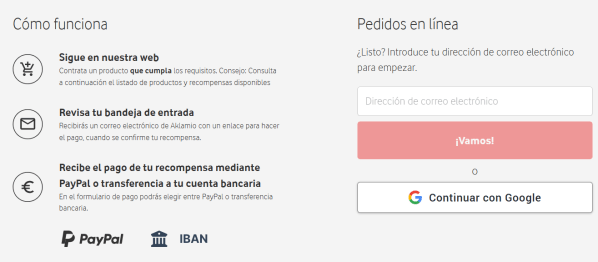
Step 2: Enter your email address or continue with Google. You will be sent to a page notifying you that you will receive an “invite a friend” reward. After about 6 seconds, it will redirect you to their special offers.
Step 3: Scroll down and choose your plan. You can either select a Wi-Fi + phone bundle (Fibra y Movil) plan with a 100 euro reward, or you could select an individual phone plan (Movil) or Wi-Fi plan (Fibra) with a 50 euro reward instead.

Step 4: After selecting your plan, input your personal details.
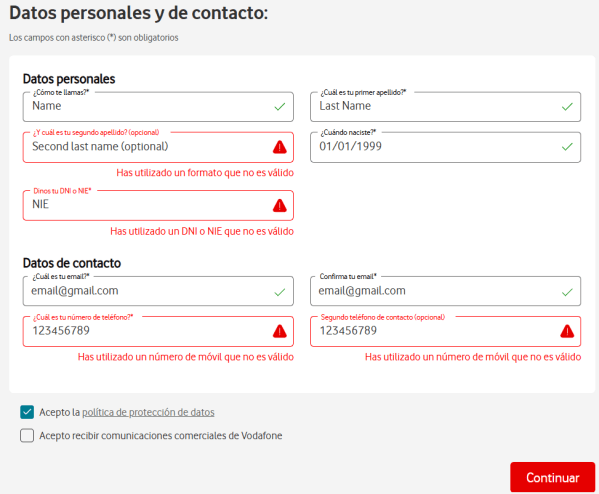
Once you finalize your purchase and start your plan with Vodafone, you’ll qualify for the reward after being with Vodafone for an extended duration (I believe either a month or a few months). It will be sent by either PayPal or a bank transfer. Congratulations!
For those that want to shop and check out the various internet plans, I will link them below:
After finding the internet plan you want, you can contact the company by phone or in person. The process may be as simple as plugging in your router, or it may require a full installation. When you sign up for a plan, the internet service provider will ask for your proof of ID (if you don’t have your NIE, you can use your passport number) along with your bank information (you need to have a Spanish bank account). They may also ask you for proof of residence (if you don’t have empadronamiento yet, you can use your rental contract).

If you found the website useful, please Support the Page. Every little bit helps.
Back to Navigation
The information on http://www.residency2spain.com is provided in good faith and is intended for general informational purposes only. Residency2spain makes no guarantees regarding the accuracy, reliability, or completeness of the content. Any decisions you make based on the information found on this site are made at your own discretion and risk. Residency2spain is not liable for any loss or damage resulting from the use of this website.
Copyright © 2022 Residency2Spain All rights reserved.

