

Once you are approved for your visa, you will be assigned a NIE. Some consulates will include your NIE in the visa itself, but others will not (Your NIE will start with X, Y, or Z followed by 7 numbers and ending with a control digit). The NIE is your identification number while in Spain, and it is incredibly useful for getting an apartment, opening a bank account, and getting a phone plan with a Spanish phone number.
If you are an EU Dual Citizen, you would get your NIE a different way.
Requirements for EU Dual Citizens
Additionally, since 2023, this number is the only way to get an appointment with the foreign immigration office for your TIE (the foreign identification card all participants need in order to stay in Spain). To successfully move to Spain and fulfill all the bureaucratic requirements, you need to have your NIE number. Regardless if you have a NIE on your visa or not, you will have a NIE number assigned to you.
Prior to 2023, you could receive your NIE when applying for a TIE. Below, you can see a TIE example:

The foreign immigration office used to allow applicants to use their passport number when applying for a TIE.
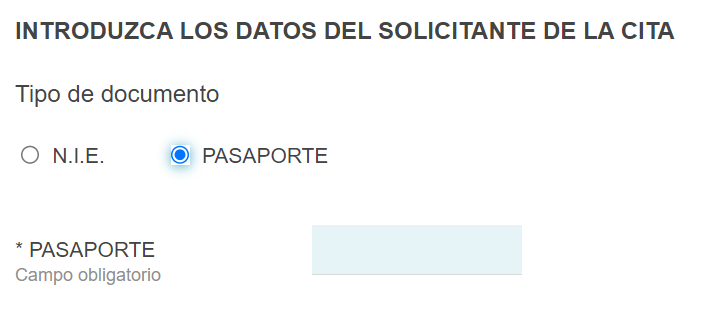
Unfortunately, this has since been changed. You must have a NIE to get a TIE appointment with the foreign immigration office

There are various methods to receiving your NIE number. Most of these will be quite simple because your NIE information already exists, some consulates just decided to make life more difficult by not including it in the visas.
Option 1 – Message the consulate where you applied for a visa: You can request your NIE information from the consulate where you received your visa. Just call or email explaining that your visa does not include your NIE and that you would need it.**
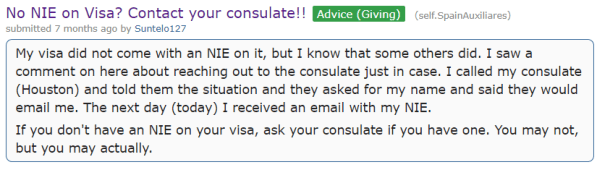
**Not all consulates will be responsive. The best time to call is as soon as the consulate opens.
Option 2 (and probably the most effective) – Contact the foreign immigration office (Extranjería): The best way to contact the extranjería about your NIE is through an email found on the information page when making a TIE appointment. I will walk you through the steps.
Step 1 – Go the extranjería appointment portal. https://icp.administracionelectronica.gob.es/icpco/index
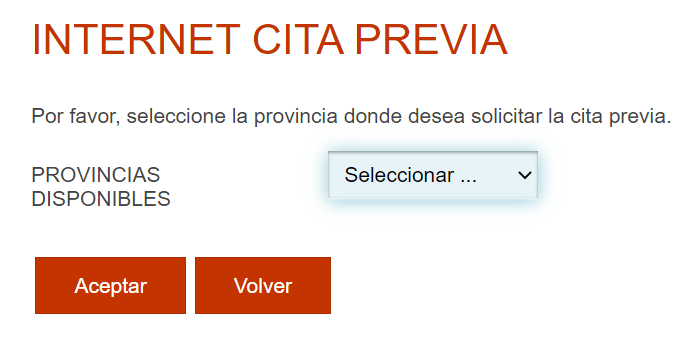
Step 2 – Fill out the following:
Provincia – The same as your previously selected choice.
Oficina – Cualquier oficina
TRÁMITES POLICÍA NACIONAL – Select this tab.
Do NOT select “TRÁMITES OFICINAS DE EXTRANJERÍA”.
“POLICIA TOMA DE HUELLA (EXPEDICIÓN DE TARJETA), RENOVACIÓN DE TARJETA DE LARGA DURACIÓN Y DUPLICADO“
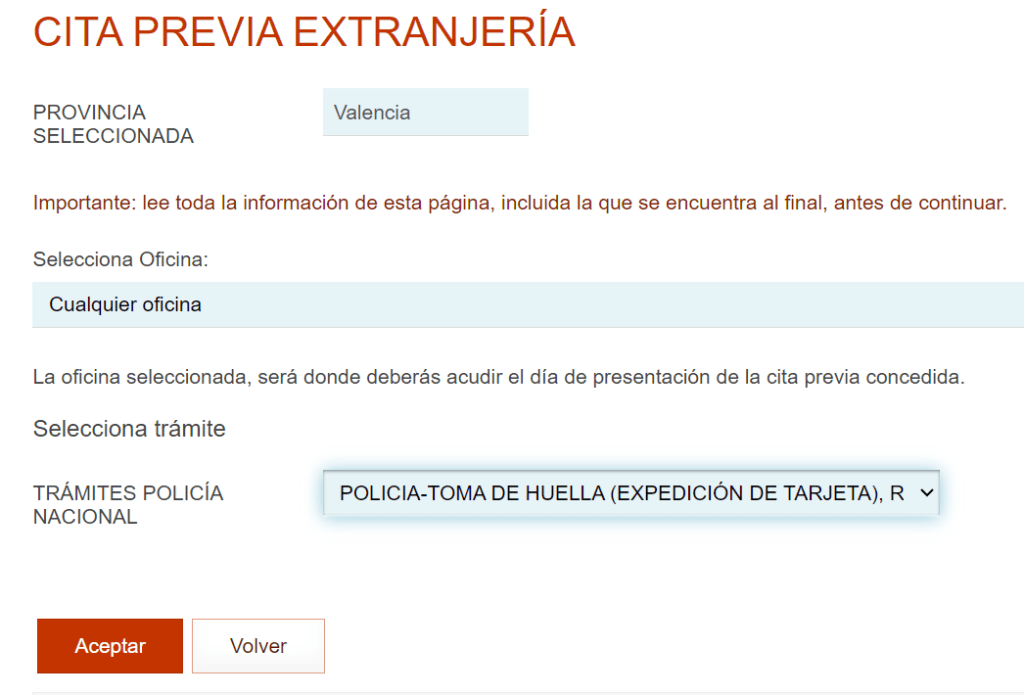
After clicking “Aceptar”, you will be brought to an information page. It discusses what documentation is needed for this appointment. Not all provinces include this, but if you do a quick search for “NIE”, you will often find an email that you can contact to receive your NIE.

“Si usted desconoce su Nº de NIE (Número de Identificación de Extranjeros) envíe copia de pasaporte y visado, por correo electrónico a consultanie.valencia@policia.es y le será facilitado.“
“If you don’t know your NIE number, send a copy of your passport and visa (in PDF format) via email to ________”
Send an email with an attachment of the visa page and data page from your passport. In the title write “Falta NIE”. In the message you can politely request your NIE number. Remember, your NIE number was already assigned to you. It´s available in a database, but you just didn´t have access to it.
If you are unable to find the information you need here, you can also do a basic search for the email address.
To find the email address of your local Oficina Extranjería, google “Oficina Extranjeria (region) Correo Electronico”.
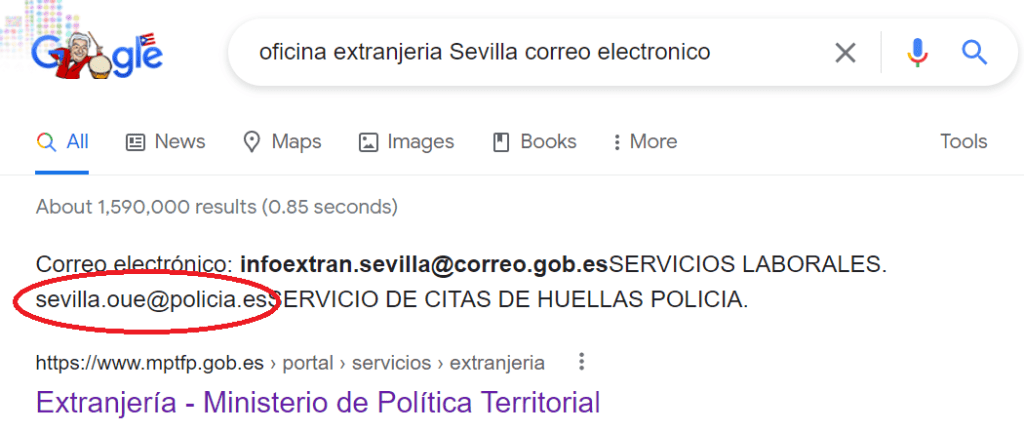
If you are really in a bind, you can walk down to your extranjeria office and ask very politely for help. They are more likely to help you if you are polite and go on a slow day when there isn’t a long queue.
“Within the first 30 days after your arrival in Spain you must go to your local police station or immigration office (Oficina de Extranjería) and request your temporary resident alien ID number (NIE – Número de Identificación de Extranjero) if you did not receive it on your visa and your residency card (TIE- Tarjeta de Identificación Extranjero).”
Source: 2026-2027 Visa Application Guide
Quick Announcement:
Running this website takes time (and money), but you can support it at no cost to yourself.
When moving to Spain, you’ll need services like a bank account, money transfers, and a phone plan. I’m an affiliate for companies I personally recommend, and my referral links often include discounts for you.
Use them when setting up your life in Spain. You save money, the site earns a small commission, and everyone benefits.

Now, back to the guide.
There is a formal bureaucratic process for receiving your NIE. This shouldn’t be necessary for auxes, however, since you are assigned a NIE when you are given a visa. For that reason, I won’t explain it in too much depth. Regardless, I will leave the basic process here:
How to apply for “asignación de NIE”
https://icp.administracionelectronica.gob.es/icpco/index
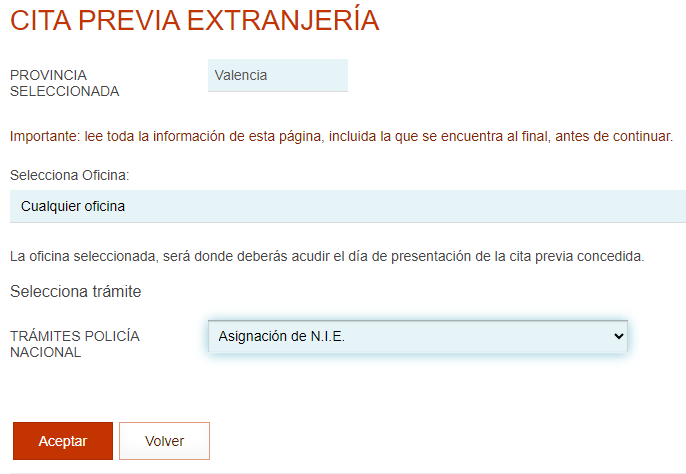
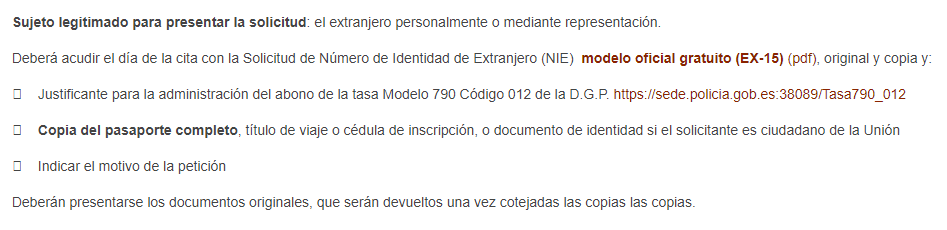
But hopefully this process can be avoided.
If you found the website useful, please Support the Page. Every little bit helps.
Back to Navigation
The information on http://www.residency2spain.com is provided in good faith and is intended for general informational purposes only. Residency2spain makes no guarantees regarding the accuracy, reliability, or completeness of the content. Any decisions you make based on the information found on this site are made at your own discretion and risk. Residency2spain is not liable for any loss or damage resulting from the use of this website.
Copyright © 2022 Residency2Spain All rights reserved.

