

Finding accommodation can be one of the scariest parts of moving to another country. You are flying to a new place without a permanent living situation, and when you arrive, you will need to very quickly find a place and sign a lease in a foreign language.
In many ways apartment hunting in Spain will be very similar to apartment hunting in the U.S, but there are some key differences as well. I will walk you through the process of finding your own place in Spain.
Before Your Flight
After Arriving
Browse/Don’t Buy Apartment Listings
Do not buy/sign/reserve any type of apartment before seeing it first in person. Housing scams exist. Do not make yourself an easy target.

Instead, before you leave for Spain, it’s a good idea to browse and familiarize yourself with key websites that will help you find an open listing. It can give you an idea of the average rates in your region. It’s also good to see what type of apartments you can expect. Make sure to plan your apartment around your commute. Check public transit options that get you to and from your assigned school. It’s also encouraged to shorten your commute if you can by living closer to your school.
https://www.idealista.com/en/ – Highly recommended link. It is the most common method of finding a place in Spain. Browse apartments and check out the posted pictures and conditions.
https://www.fotocasa.es/en/ – This is another commonly used website for renting apartments in Spain. Just like Idealista, you can browse apartments and check out the posted pictures and conditions.
Join specific Facebook groups for housing in your region. You will find many different posts advertising available rooms and apartments. Remember, do not sign or buy anything before seeing it in person!

IMPORTANT ADVICE: DO NOT make posts online giving your budget for an apartment. Many auxiliaries are widely unaware of the market rates for renting apartments in Spain. They grossly overbid on apartments by posting high budgets online. This not only makes it difficult for natives to find apartments, it also raises the cost of renting overall for everyone!
Do not make a post like this:
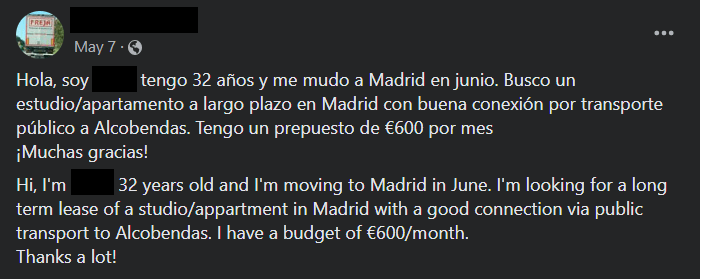
Later on when you are searching for apartments while in Spain, you can just respond and apply to advertised openings on Facebook, Idealista, or Fotocasa.
Join specific Facebook groups for auxiliaries in your region. Auxiliar de Conversación groups will have posts looking for roommates around the time of entry.
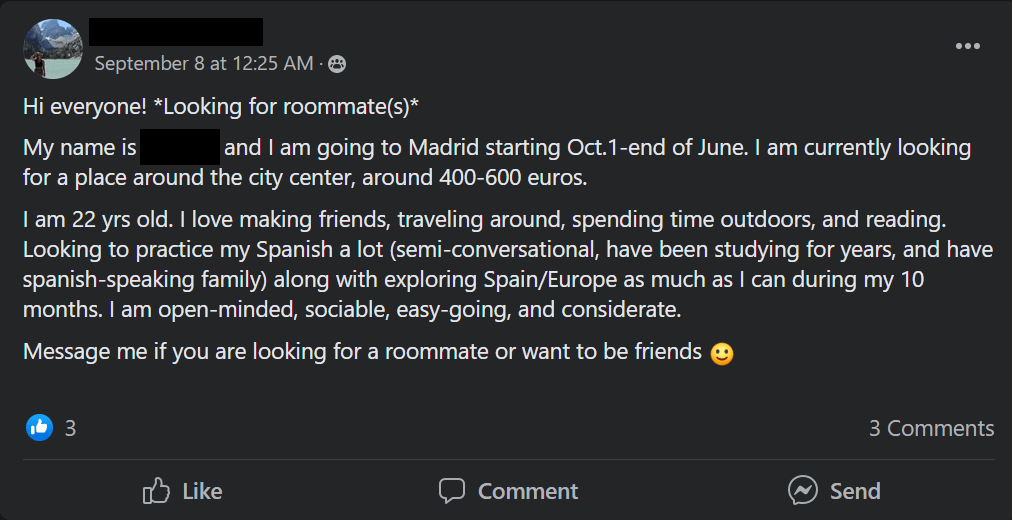
You should also prepare a short, 50 word introduction (in Spanish) for when you apply for an open listing. Mention who you are, the program you are in, and how long you will need the lease. You can give some information about your interests and background. Talk yourself up. In my experience, landlords are more eager to rent to people they like. You can copy and paste this message to emails, WhatsApp numbers, and open postings.
If you are placed in a small town without these resources, you can ask for help through your school. More than likely a teacher or family member of a teacher or student will have a room available.
Set Up Temporary Accommodation
Since you are not leasing an apartment before flying to Spain, you need to plan your temporary stay while looking for a place.

https://www.airbnb.com/ – Great option for temporary stay upon arrival (3-7 days would be a good short term stay while you look for an apartment. You can also discuss possible extensions if you have difficulty finding an apartment.)
https://www.couchsurfing.com/ – This is another cheap option for temporary stay upon arrival. I personally prefer airbnb, but couchsurfing can let you dive head first into meeting the locals.
Find an affordable hostel – A hostel is a great option as well for many people. Rates can be as low as €20 a night. A big issue, however, is that many hostels have shared rooms. If you are sharing a space with strangers, you need to make sure that your belongings are secure while you are busy looking for an apartment. If the hostel has secured lockers, use them. Lock up your belongings, and don´t leave valuable items unattended.
Getting an Apartment in Spain (and What to Expect)
You’ve been browsing apartment listings and have narrowed down your search to a handful of apartments. You’ve also prepared your introduction message in Spanish, and you are finally able to visit the apartment in person. Now is the time to send introduction messages showing interest in the apartments within your budget and in a good location.
Usually, the most responsive method of communication is WhatsApp. Either send a message or make a phone call if you are confident in your Spanish.
After getting a response, you can try to schedule a date and time to visit the apartment. Before you visit the apartment, try to prepare some important Spanish phrases in advance.
¿El alquiler incluye gastos? – Does rent include utilities?
¿Tiene lavavajillas y lavadora? – Does it have a dishwasher and washing machine?
¿Cuánto es la fianza? – How much is the deposit?
¿La habitación/el apartamento esta interior o exterior? – Is the room/the apartment interior or exterior?
¿El piso está amueblado? – Is the flat furnished?
¿Tiene internet? – Does it have internet?
¿Está la comunidad incluida? – Is the community fee* included?
*The community fee is a monthly fee that helps pay to maintain communal spaces like the pool and patio.
It is quite typical to pay 3 months rent when signing an apartment. The landlord will ask for 1 month as a deposit, 1 month for the first rent payment, and 1 month for an agency fee (Since 2023, it has been illegal to charge long-term renters, contracts of a year or more, the agency fee. Regardless, many landlords continue this practice). Of course, if you hire an agent yourself to find an apartment, you’ll be expected to pay a fee.
Many property owners that rent out apartments don’t want to deal with landlord responsibilities such as finding a tenant and communicating and resolving maintenance issues. Instead, they hire an agency. Additionally, some landlords may ask for 2 months deposit (Again, this is also illegal).
You have 3 options to make these initial payments. For those that were able to open a bank account without a permanent address yet, you can make a simple domestic transfer.
Getting a Spanish Bank Account + First Day Finances
Another great option would be to make a transfer using Wise.com. You can transfer the money with the funds from your bank account. Wise will charge you a small transfer fee, but it won’t be very expensive at all. In fact, Wise often has the best transfer rates.
If the previous options don’t work for you, you can sometimes pay in cash or make a bank transfer by paying with cash at your landlord’s bank (go to a branch of your landlord’s bank. Bring their bank details with you, and pay in cash to make a direct transfer).
Sometimes, the landlord will require you to provide a NIE when contracting an apartment. Some consulates provide the NIE on the visa page, but other consulates do not. You can see an example of this below:

For those that do not have a NIE, you can receive it by requesting information from your local Oficina Extranjería or from the consulate where you got your visa.
Warning: many landlords like to avoid paying taxes on their rental income. They may be hesitant to sign their half of the contract, and this can make it more difficult to apply for empadronamiento* in the future. They may also just outright refuse to allow tenants to empadronarse at that address.
I highly highly highly recommend getting an official rental contract and being able to empadronarse. It protects you from shady business by the landlord, and it’s required for other bureaucratic steps.

*Empadronamiento is a way of registering where you live. To apply for a residency card, it is necessary to have a certificado de empadronamiento. You need an application form, your ID, and proof of residence (a signed rental contract or utility bill in your name) to apply for this certificate.
Congratulations on getting your permanent address! Quick word of advice, make sure to air out your apartment at least twice a day (especially in times of higher humidity). Unlike a lot of homes we are used to, it is absolutely crucial to circulate the air to avoid mold.
After you get a permanent address, you can apply for empadronamiento.
You can also work on getting your first TIE.
Setting Up WIFI

Some apartments can be rented with WIFI already set up beforehand, but this has not been my experience in Spain. Usually, the tenant needs to sign up for an internet provider. Just like with getting a cell phone plan, internet providers in Spain have low rates compared to what you get back home and provide high quality service. In fact, many of the same cell phone companies also provide internet service.
If you’re interested in a special offer through Vodafone that rewards 50-100 euros, please follow the info below. If not, you can find other competing options afterwards.

(Vodafone Reward code for 50-100 euros off)
How to qualify for the reward:
Step 1: Click on the above link.
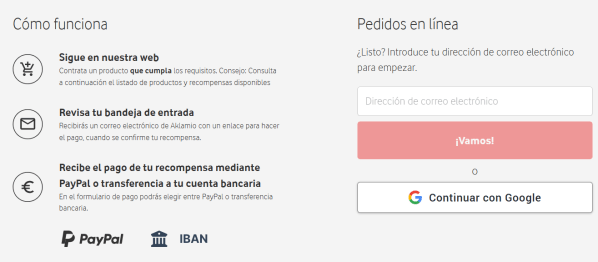
Step 2: Enter your email address or continue with Google. You will be sent to a page notifying you that you will receive an “invite a friend” reward. After about 6 seconds, it will redirect you to their special offers.
Step 3: Scroll down and choose your plan. You can either select a Wi-Fi + phone bundle (Fibra y Movil) plan with a 100 euro reward, or you could select an individual phone plan (Movil) or Wi-Fi plan (Fibra) with a 50 euro reward instead.

Step 4: After selecting your plan, input your personal details.
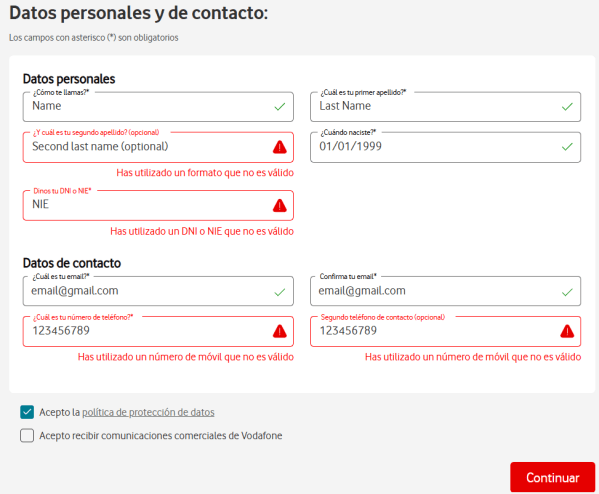
Once you finalize your purchase and start your plan with Vodafone, you’ll qualify for the reward after being with Vodafone for an extended duration (I believe either a month or a few months). It will be sent by either PayPal or a bank transfer. Congratulations!
For those that want to shop and check out the various internet plans, I will link them below:
After finding the internet plan you want, you can contact the company by phone or in person. The process may be as simple as plugging in your router, or it may require a full installation. When you sign up for a plan, the internet service provider will ask for your proof of ID (if you don’t have your NIE, you can use your passport number) along with your bank information (you need to have a Spanish bank account). They may also ask you for proof of residence (if you don’t have empadronamiento yet, you can use your rental contract).

If you found the website useful, please Support the Page. Every little bit helps.
Back to Navigation
The information on http://www.residency2spain.com is provided in good faith and is intended for general informational purposes only. Residency2spain makes no guarantees regarding the accuracy, reliability, or completeness of the content. Any decisions you make based on the information found on this site are made at your own discretion and risk. Residency2spain is not liable for any loss or damage resulting from the use of this website.
Copyright © 2022 Residency2Spain All rights reserved.
-
Behind the Scenes – 2025 Finances
How does Residency2spain.com make money, and how much money does it make? I’ve just finished crunching the numbers and can elaborate on how these guides stay financially solvent. If you are motivated, have a unique idea that can help others, and want to make some money on the side, you can try creating a website…

-
Some Good News
Proceed with caution. Although the state of the program may be uncertain, there have been some positive signs (not guarantees) for 2026-2027. If you are unfamiliar with what is happening with the auxiliary program, please check out the previous post. As you are probably aware, the auxiliar de conversacion program is being restructured for 2026-2027.…

-
The Future (or End) of the NALCAP Program
Restructuring of the program, multi-million euro fines, and a delay to the application window! Expect major changes to the NALCAP program. If you’d like to keep up-to-date on what’s happening, you can joinMy Auxiliary Facebook group. Some Good News In 2025, the region of Andalucia was fined by the central government for a failure to…
-
A Podcast?
I’d like to share the podcast I have just started with my audience. it’s called Immigrant, not Expat. My goal is to share stories about immigration to hopefully remove the negative connotation surrounding the word “immigrant”. I am deliberately avoiding the word “expat” because I don’t want to reinforce a caste system for immigration. I…

-
Culture Shock!
People who talk about moving to another country may emphasize how different the culture will be and how to deal with culture shock. Spain is a modernized, western country that isn’t too different from the U.S, so in my experience, “shock” isn’t a great way to describe it. There are some differences, though. Most of…
-
250k Views – Day in the Life
The last time we celebrated a view benchmark, I made a post about myself and what led me to create a life in Spain. Now that we’ve hit 250,000 views, I’m posting feet on main! (Open the full image if you are a sicko). Well, the idea of this post is to share a typical…

-
Santiago de Compostela
On an extended weekend, thanks to a public holiday, my partner and I went to Santiago de Compostela. It’s a beautiful city in the northwestern region of Galicia, which is known for its rainy climate and delicious food. Santiago is an interesting city with a unique history. It is the destination of multiple pilgrimage routes…

-
Extra Income – Teaching Online
There are countless ways of saving money while in Spain, but if you want to be able to travel more and enjoy more experiences, increasing your income is a great way to do that. As native speakers of English with experience teaching English as a foreign language in Spain, your teaching services will be in…
-
Saving Money and Being Environmentally Friendly
You don’t need your own terrace garden like me, but you can easily save money and be better for the environment when living in Spain. One of the joys of moving to Europe is that it becomes possible to be environmentally friendly without sacrificing your lifestyle or money. When I lived in Indiana, I remember…

-
Celebrating 75,000 Views – My Journey to Spain
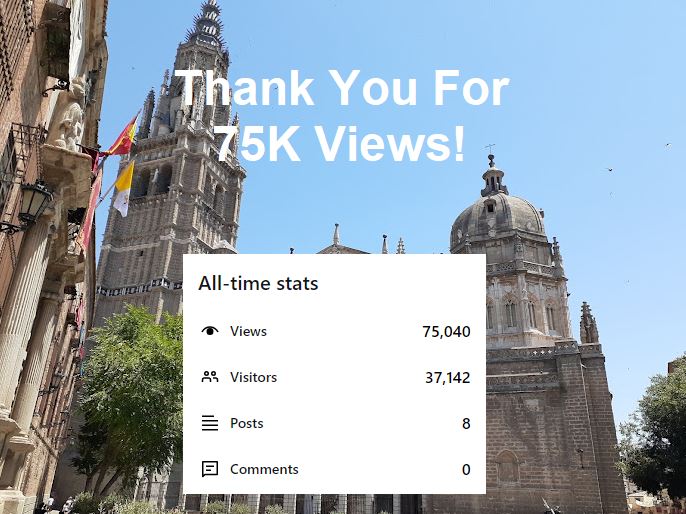
When I first started writing this blog, I never expected getting this type of interest. I just wanted to create something to help others find their lives in Spain and avoid the uncertainties and anxieties that plague bureaucratic processes here. It’s still only a hobby instead of being my actual job, but a lot of…
-
Spanish and U.S. Library Cards
Getting a U.S. library card before leaving for Spain and a Spanish library card while there can provide wonderful (free) services. Libraries have modernized. They provide a wide range of services that can be accessed from anywhere in the world: eBooks, audiobooks, as well as online magazines and newspapers. Individuals travelling to or living in…

-
How I Accidentally Became an Actor in Spain
“Quiet on set, roll cameras, and action!” I desperately choke for breath while grasping at my wounds. With a WW2-era revolver aimed at the entryway of an abandoned farm shed, I am slowly bleeding out while waiting for my enemies to finish me off. Suddenly, I hear noises just outside. It sounds like footsteps, and…

-
NALCAP Webinar 2022 – Highlights
July 28, 2022 Will new regulations affect auxiliares who receive supplemental income in Spain? What should I do before leaving for Spain? How do I find an apartment? What steps should I take first when I arrive in Spain? The 2022 NALCAP webinar covers topics that can help new auxiliaries and returning auxiliaries. Find out…

-
Fun Trips around Madrid
Cercedilla Cercedilla is a mountainside municipality Northwest of Madrid. It is about an hour train ride away with the cercanía trains from Atocha (the main train station). The mountainside is filled with nature, flowers, and there is a small ranch with a herd of cows living their best lives grazing on the mountainside. The cows…

-
Budgeting in Spain
The cost of living is much cheaper in Spain, but the salaries are also much lower. How do I budget? What should I expect to spend and save? Just like the U.S, some places in Spain are more expensive than others. Madrid is one of the most expensive cities in Spain, so if you live…

-
The debate of the century: with or without onion.
Spanish tortilla is a traditional dish in Spain similar to an omelette. It has eggs, potatoes, and sometimes diced onions. In Spain people are passionate about food, especially traditional food, and there is a fierce debate in Spain about which type of tortilla is better: with or without onions. Traditionalists will claim that putting onions…

-
So, you want to move to Spain?
There are many reasons to want to live in Spain. The climate is warm and pleasant. The natural landscapes are breathtaking, and with a guaranteed 22 vacation days a year, you have the time to enjoy them. Culturally, Spanish people are kind, welcoming, and outgoing. This generosity also includes the public services offered. Spain has…

 Spanish Bureaucracy Guides