

The non-lucrative visa, also known as the non-working residence visa, is a visa to reside in Spain without carrying out any gainful (work or professional) activity, provided that the applicant has sufficient and guaranteed means to live on. This visa does not constitute a work permit.
Although individuals with this visa are not given a work permit, the NLV provides a pathway towards permanent residency (with work permission) as well as eventual citizenship. After having completed 5 years of legal and continuous residence in Spain, you can apply for permanent residency. In this application, you will have to prove your continuous residency* as well as provide a clean criminal background check.
*Continuous Residence is defined as not being outside of Spain 6 months in any 1 year period, or a total of 10 months during the first 5 years of residency. You must show proof of continuous residence in Spain as well (bank transactions, flight details/boarding passes, passport stamps, etc.)
After residing in Spain for 10 years, you will meet the residency requirement for citizenship. For individuals from any Latin country, Andorra, Equatorial Guinea, Philippines, or Portugal, the requirement is reduced from 10 years to 2 years to qualify.
To get an idea of what it takes to receive the NLV, I’d like to go over the various requirements.

Criteria:
Financial Means
Health Insurance in Spain
Criminal Record Check (and relatively clean result)
Medical Certificate
Proof That You Are No Longer Working*
*Only required by some consulates.
Example NLV Checklist (Boston Consulate):
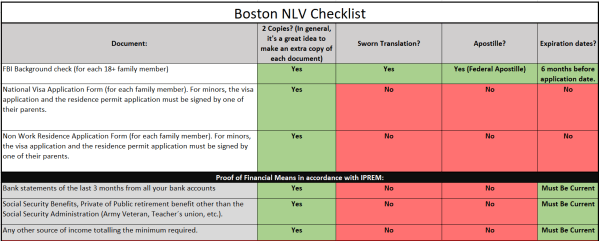
Each Spanish consulate will have slight differences in the application process for the same visa. Where you are geographically located will determine which Spanish consulate you will apply to. For that reason, I will not go into much depth on each requirement. These are general guidelines. For in depth, step-by-step instructions on the non-lucrative visa application, see your respective consulate page.
How Much Money Do I Need to Qualify?
Those who wish to apply for the NLV need to provide sufficient financial means to cover the expenses of residing in Spain for the initial year of the residence permit, or prove that they have a regular source of income, for themselves and, where applicable, for the family members accompanying them. Additionally, each renewal of the permit would require further proof of funds.
https://www.immigrationspain.es/en/renew-non-lucrative-visa/#Sufficient_economic_funds
Remember, you will be prohibited from working during this time, so any income would have to be 100% passively earned. Think pensions and social security.
The minimum required amount is equivalent to 400% of Spain’s Public Multiple Effects Income Indicator (IPREM). An additional 100% of the IPREM must be added for each family member in the applicant’s care. As with other similar indicators in other countries, the IPREM is established by the government and corresponds with increases in the cost of living.
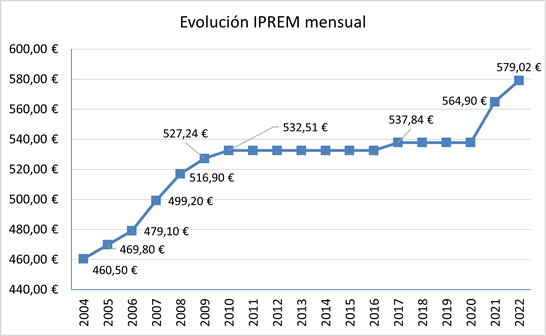
As a concrete example, imagine an application in 2023 with 1 dependent. The yearly IPREM in 2023 was 7,200 euros. You need to provide 400% of this value for yourself as well as an additional 100% for each dependent. This would add up to be 36,000 euros or just over 39,000 dollars.
The IPREM is published annually through the Ley de Presupuestos. You can find further information about it here:
Comprehensive Spanish Health Insurance
Applicants must also obtain public or private health insurance contracted with an insurance entity authorized to operate in Spain. The insurance policy must cover all the risks insured by Spain’s public health system.
This means that the cheapest insurance plan available wouldn’t suffice. Uninsured individuals could become financial burdens on the public healthcare system, so you are required to purchase health insurance that matches the coverage of the public health system in Spain.
When I applied for a visa in Spain, I purchased Adeslas Plena Vital.

FBI Background Check
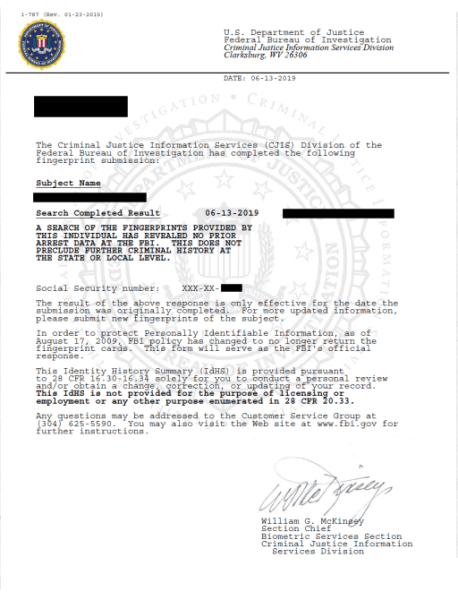
You are required to submit a recent FBI background check with the Apostille of the Hague (the Apostille is just a form of authentication. It is used to certify documents for international use).
Individuals applying for a visa with a criminal record aren’t always denied simply for having a record. Each application will be handled on a case-by-case basis, but they will take into account the severity and nature of the crime, the time that has elapsed since the offense, and the likelihood of a repeat offense.
Medical Certificate
Don’t worry about your bum knee, diabetes, or any other non-contagious health conditions you may have. The medical certificate is only to verify that you won’t be a threat to public health in Spain, so unless you are harboring the next pandemic, you will be fine.
The consulate will provide you a medical form that needs to be filled out, signed, and stamped by an MD. The form itself has an expiration date. It must not be over 90 days old when attending your visa appointment, so make sure to check your calendar before scheduling an appointment with your family doctor.
Here is an example below:
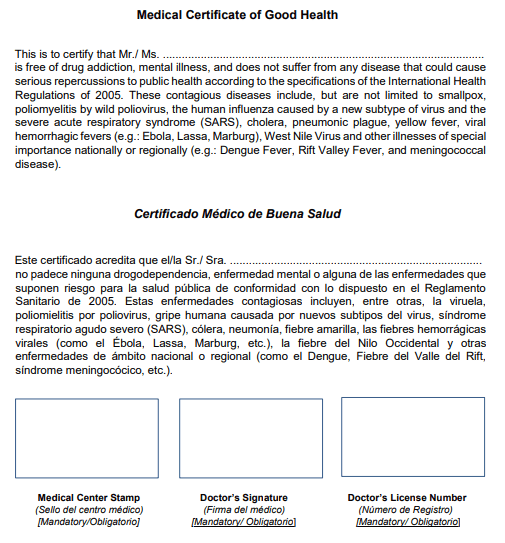
Notice how the form is only concerned with highly contagious diseases that could pose a threat to a country’s public health such as smallpox.
Proof That You Are No Longer Working*
Not all consulates specifically request proof that you are no longer working, but the ones that do offer 2 options:
Working Age Applicants: “you will need to prove receipt of a pension or provide a termination letter from your employer stating that you will no longer work for that company or, in case of self-employment, you will need to provide an affidavit before a Notary stating that you agree not to work while residing in Spain.”
Retirees: “In the case of retirees, the applicant must be a beneficiary of a State pension in convertible currency or be a beneficiary of a life annuity, not capitalizable, payable by a public or private institution in convertible currency and / or investment accounts. Attach bank statements from the last three months and a copy of the last tax return.“
Find Your Consulate
Before collecting all your documents and preparing for your visa application, it is important to know which consulate you need to prepare for. Below, I have a map of the Spanish consulates in the U.S.A. It is color coordinated to help find your regional consulate. You must go to your regional consulate. For example, I am from Michigan, so I went to the consulate in Chicago. I am not allowed to apply for a visa at any other consulate except for the one in Chicago.
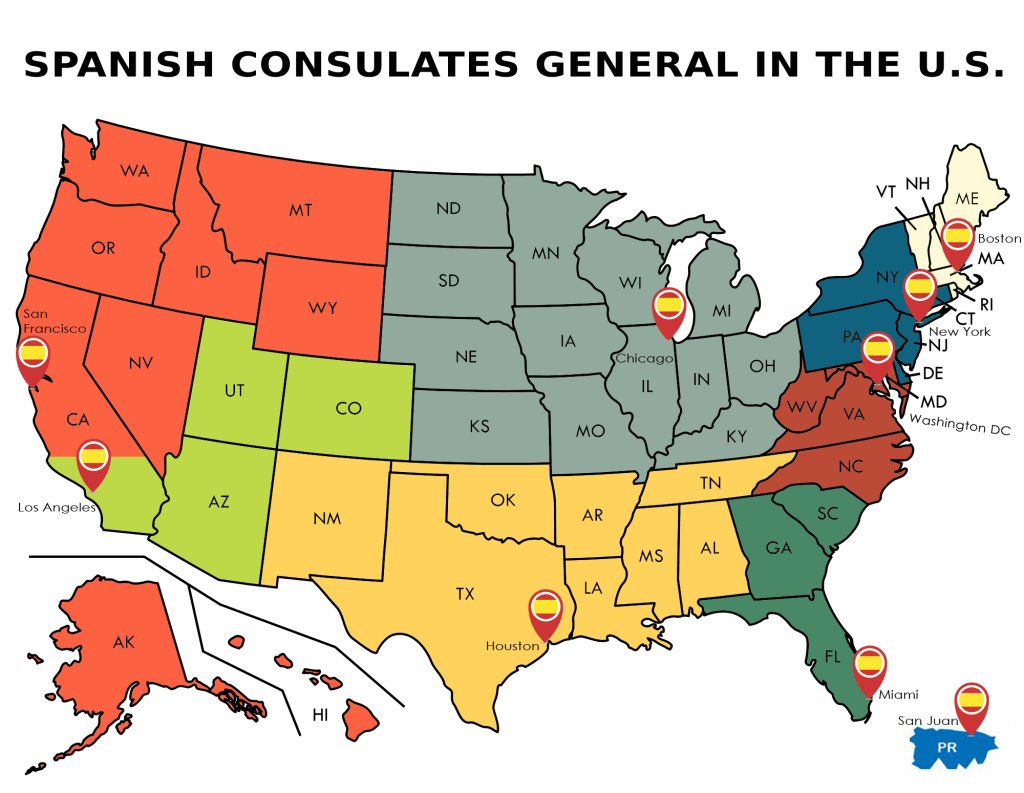
Generally, the requirements will be very similar between consulates, but there are some crucial differences between each consulate you go to. The documents you prepare and the methods of getting an appointment can be slightly different between consulates. These requirements can also be changed depending on current circumstances.
I applied through the Spanish embassy in Chicago. At the time it was required to present the visa documents in person. In other times, the Chicago embassy allowed mail in applications due to the high demand. After you find your consulate, I will explain how the process can be different and give resources to help you apply for your first visa.
Choose Your Consulate


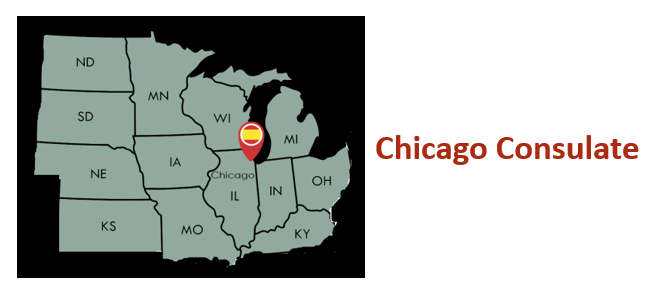


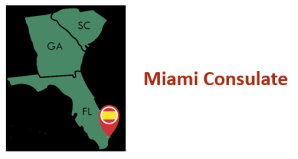


Guidelines and requirements can be changed at a moment’s notice. Triple check everything with the consulate’s website.
I am not a lawyer. I am sharing the information from the respective consulates’ websites along with my personal experiences in an organized manner.
FOLLOW THE EXACT INSTRUCTIONS FROM YOUR RESPECTIVE CONSULATE.
After you have successfully completed your visa application during your appointment at an embassy, you will have 3-6 weeks to wait for the visa to be processed and sent back to you (or retrieved).
Once you arrive in Spain with your visa, you will need to complete more paperwork to receive the foreign residency card (TIE). This will be covered later. In the meantime, start looking for a good flight because after receiving your visa, you have a finite amount of time to get to Spain.
If you found the website useful, please Support the Page. Every little bit helps.
Back to Navigation
The information on http://www.residency2spain.com is provided in good faith and is intended for general informational purposes only. Residency2spain makes no guarantees regarding the accuracy, reliability, or completeness of the content. Any decisions you make based on the information found on this site are made at your own discretion and risk. Residency2spain is not liable for any loss or damage resulting from the use of this website.
Copyright © 2022 Residency2Spain All rights reserved.

